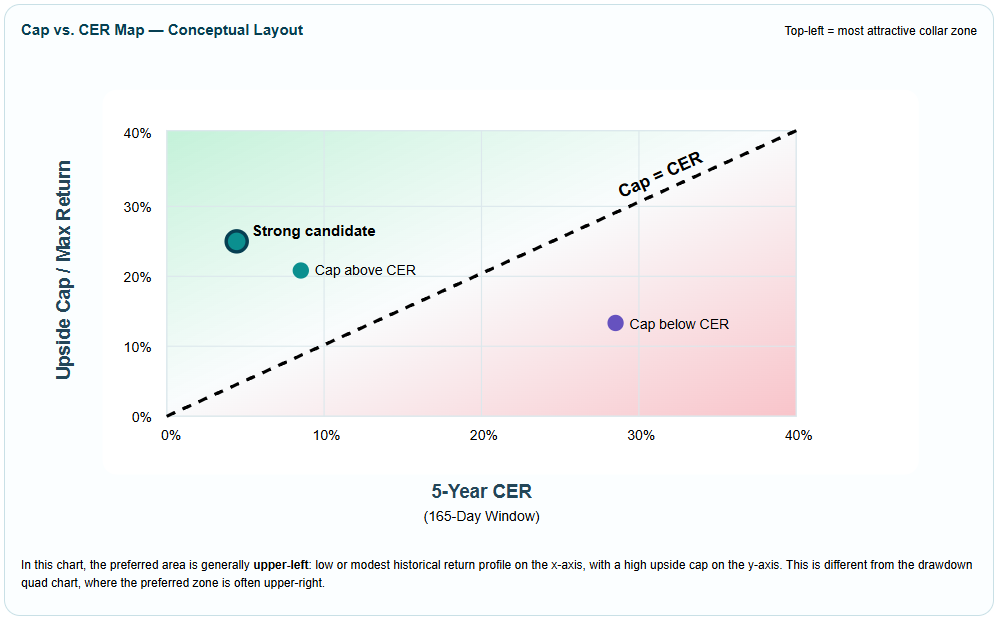
The Setup: Starting this week, Volworks is publishing regularly on how advisors should and shouldn’t use options on the stocks and ETFs they already own. Here is what we’ll cover, and the myths we plan to retire.
It has been a while since I published anything here. That changes this week.
For most of the past year, we have been building rather than writing: a platform that screens, models, manages, and reports on options strategies for stocks and ETFs an investor already owns, and a complimentary Covered Call Report that a growing number of advisors have been requesting. In the conversations that followed those reports, the same questions kept coming up. Which call should I sell? Is this premium any good? What do I do when the stock runs through my strike? How do I explain any of this to a client?
Those are the right questions. Most of the answers advisors have been handed over the years are about half right. So, starting now, Volworks will publish one article every Tuesday, with shorter posts around it during the week, on how advisors should use options, when they shouldn’t, and what actually determines whether an options program works.
Why we are writing this, and where the topics come from
None of the topics in this series were chosen in a conference room. They come from the questions we hear every day from clients, prospects and people in the markets, and from the questions I have been asked over more than 25 years working with family offices, RIAs and institutions that run covered call programs. The questions have barely changed in that time. The tools have. That gap is the reason for the series.
So when a piece takes on a myth, it is because someone asked us about it last week. When a piece explains a number, it is because an advisor told us they could not explain it to a client. If you have a question we have not covered, send it. There is a good chance it becomes a Tuesday article.
Who this is for
You run an advisory practice, or you manage your own money, and you already write covered calls, or you have been meaning to. You are not an options trader and have no interest in becoming one. What you want is a repeatable process, a way to know whether it is working, and a way to explain it to a client in a sentence or two.
That is who I am writing for. If you trade volatility for a living, you will find this basic. That is by design.
One note for readers further up the sophistication curve: the Volworks platform also carries modules and analytics built for hedge funds, pension managers, endowments and other institutional investors, and we will be writing pieces aimed squarely at those audiences. This series is not that. It is for advisors and self-directed investors, and I will keep it there.
What we’ll cover
Covered calls first, for the next several weeks, because that is where nearly every options program starts and where most of the bad habits live. Then Boosters, a trade I think is the best one almost nobody does. Then put writes, and put spread collars for the positions you would rather protect than cap.
Across all four strategies, every piece will come back to the same five questions:
1. Should you do this trade at all?
Earnings, catalysts, what the stock has historically done into this expiration, and how it has been behaving lately all come before strike and premium.
2. What should you write?
Expiration, strike and delta are a choice between income and room to run. There is no default.
3. What do you do once it’s on?
Close early, roll down, roll up and out, or hold. Each is a decision, and the calendar will not make it for you.
4. Did it work?
The stock and the option are one strategy. Judge them together, over any period, not as two lines on a statement.
5. Can you do it across every account?
A hundred accounts, two positions each, twelve cycles a year is roughly 2,400 decisions. Judgment needs a system.
Two things I would most like to change your mind about
Premium isn’t everything. Option premium is the market’s price for expected movement. When a screen sorts covered calls by premium, it pushes the most volatile names, and often the ones with an earnings report coming, to the top of the list. Those are exactly the stocks where a cap hurts the most. You collect a little more income and hand over the part of the move that mattered. The better question is not how much premium is available. It is whether that premium is enough to cover the upside you are giving up, given what the stock tends to do in this specific window.
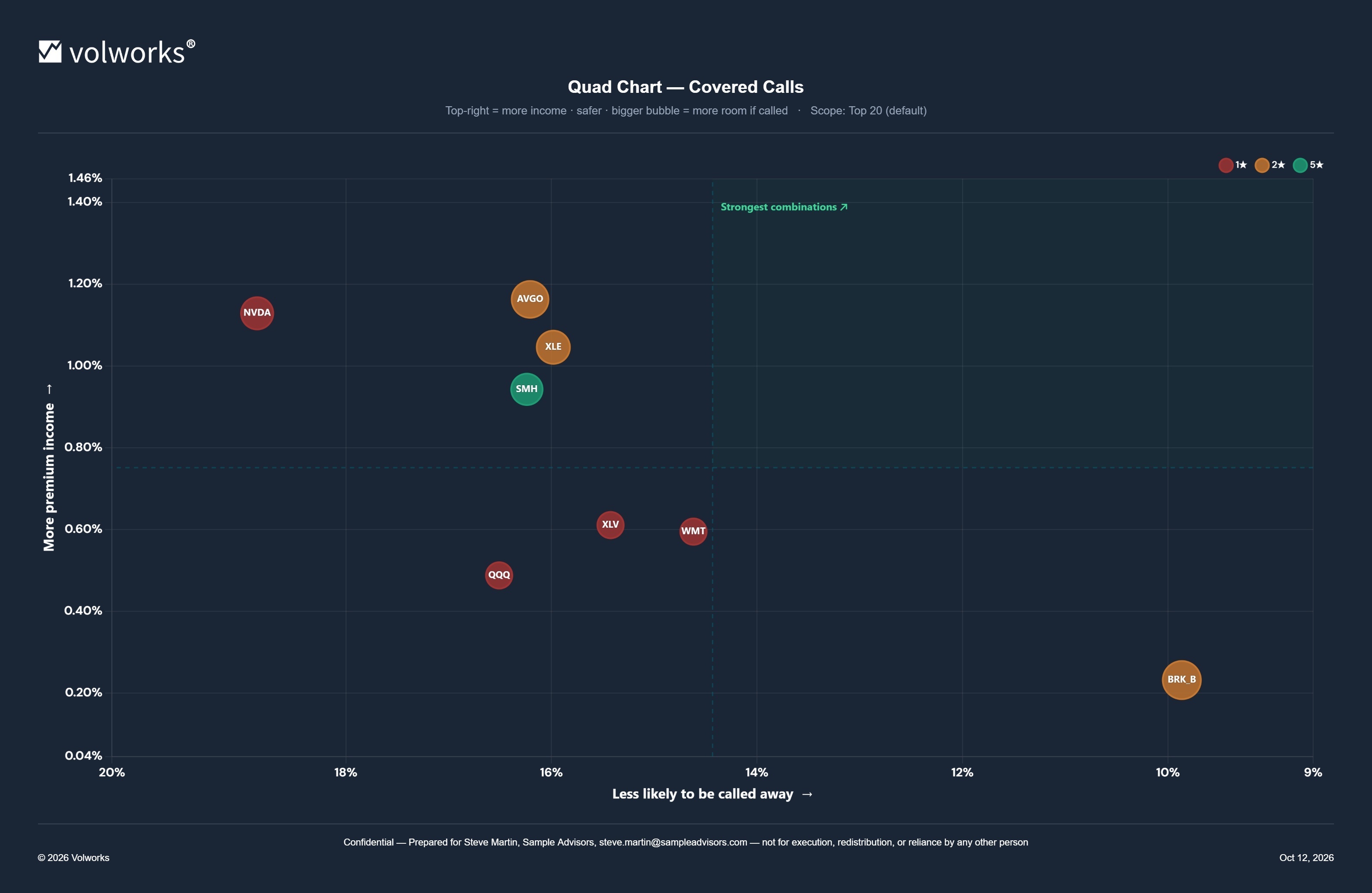
This Quad Chart, generated directly from the Volworks platform, highlights 8 stocks/ETFs from the Volworks Core 20 Portfolio. The remaining 12 stocks are excluded due to upcoming earnings announcements.
Management matters more than selection. This is the one I feel most strongly about, because it runs against almost everything advisors are told. Conventional wisdom says a conservative covered call needs attention maybe 15 to 20 percent of the time. Over a full market cycle, our own research says it is closer to 65 percent, and that matches my experience managing covered call positions for large family offices and institutions over more than 25 years. Expiration-date probabilities ignore everything that happens along the way: the stock that runs through the strike in week two, the call that has already lost most of its value with half the days left, the market that turns and makes the strike you sold look generous. Selling the call is the easy part. The outcome is decided by what you do next.
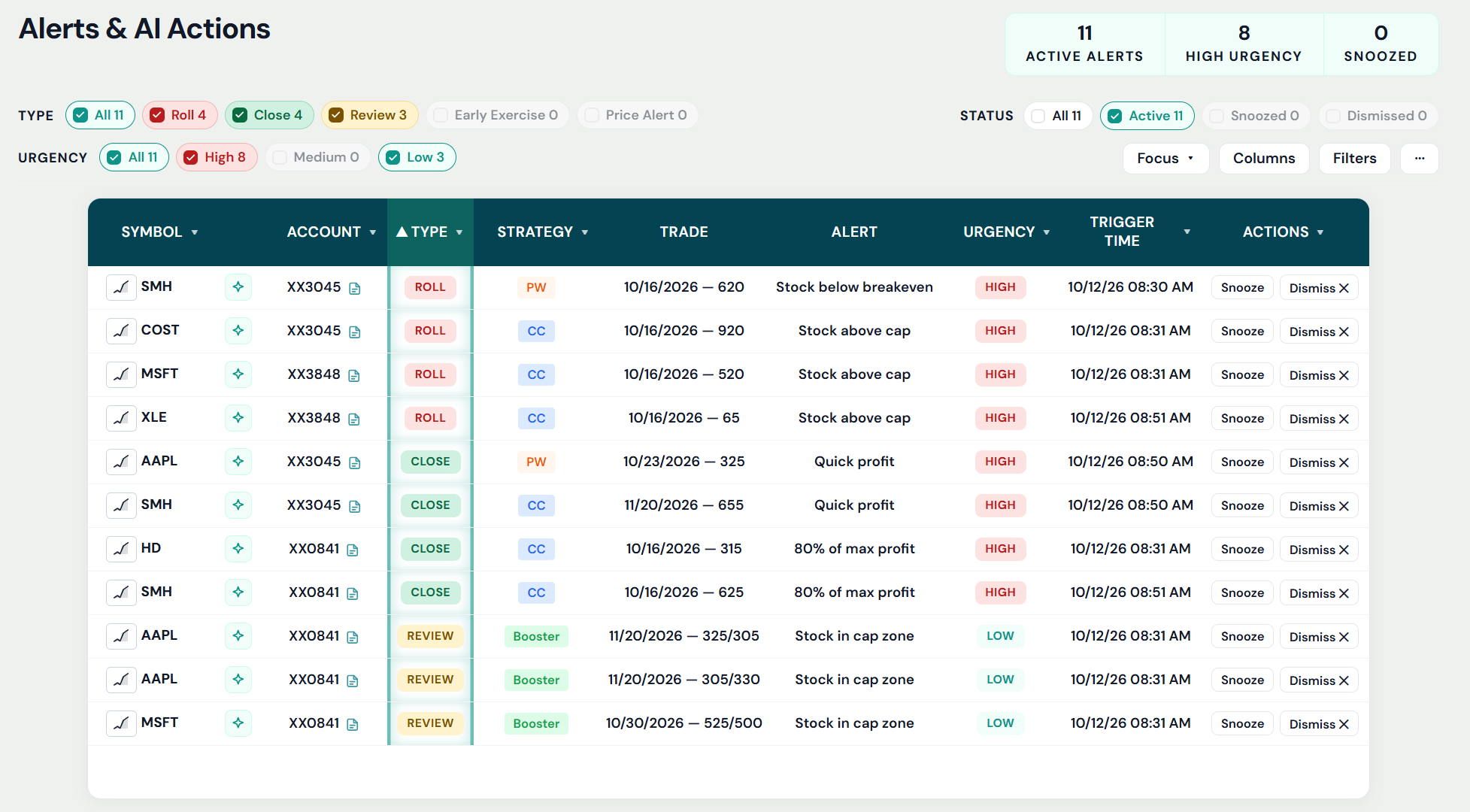
This screenshot, taken directly from the Volworks OPMS platform, highlights AI-Action Alerts™ that continuously monitor open options positions and identify when to Review, Close, or Roll. The platform helps advisors navigate four key decisions—Hold, Review, Close, or Roll—while keeping the final decision in their hands.
Better numbers than the ones you are used to
Most covered call decisions are made with three numbers: the premium, the strike, and days to expiration. Over the coming weeks we will introduce a few more, each one chosen because it changes the decision rather than decorates a screen.
Probabilities.
The modeled probability that the stock finishes above your breakeven, which is the real odds of giving up upside, and the probability of finishing above the cap. Delta is not that number, although it is often used as if it were.
CER™, and why seasonality matters more than you think.
Contextual Expiration Return is our measure of what a stock has historically done between today’s date and this specific expiration, over the past five years (Volworks has up to 20 years of data for each symbol), weighted toward recent years, in calendar days. The reason it matters is simple: the same stock does not behave the same way into every window. A name that has rallied into mid-November four of the last five years is a poor candidate to cap in October, however good the premium looks.
Why you cannot always rely on averages.
An average annual return tells you almost nothing about a 30-45 day window. Averages flatten exactly the pattern you need to see: the strong stretches and the weak ones, and when they tend to fall. Two stocks with the same one-year return can have opposite histories into the same expiration. We will show you names where the five-year history flips sign from one expiration to the next, on the same screen, on the same day.
None of these numbers is a forecast. They are context, and they are better context than premium alone.
A word on AI
There is a growing belief that you can hand all of this to an AI agent: tell it to pick the calls and manage the positions, and walk away. We build AI into our platform, so I have some standing to say this: that belief is a myth, and acting on it with client money is a mistake. Models are good at screening thousands of combinations, explaining a rating in plain language, and flagging the position that needs a decision this morning. They are not good at knowing that a client cannot take a realized gain this year, that a position is part of a larger plan, or when a rule should be broken. The useful question is not whether AI can run the program. It is which parts of the work it should do, and which parts it should hand back to you. We will write about that specifically, including how we use VERA™, our own AI analyst, and where we deliberately stop it.
Myths we are going to retire
A few we will take on in the coming weeks, each in its own piece:
- Covered calls are only for generating income. (Some investors use them as an exit strategy; others use them for a measure of downside cushion. All three are legitimate, and they call for different strikes and different management.)
- The highest-premium call is the best call.
- Earnings mean more premium, so it is a good time to write.
- There is a “best” delta.
- A conservative covered call rarely needs attention.
- Getting called away means the trade failed.
- A cap is a hard cap.
- Hedging is too expensive to bother with.
- Your brokerage statement tells you whether your options program works.
- AI can do all of this for you. Just program an agent to pick and manage the positions.
One assumption, stated up front. The vast majority of investors who write covered calls do it to supplement income on stocks and ETFs they already own and intend to keep, and most of them are tax-sensitive: selling the shares means realizing a gain they would rather not realize. That is the reader I will assume, and it's why so much of this series focuses on management and rolling rather than selection. If you cannot simply let the stock be called away, what you do when it runs through the strike becomes the whole game. Using covered calls as an exit strategy is a different objective with different rules, and it will get its own article later in the series.
Two promises
Plain English.
If I need a term, I will define it the first time and then use it. You will not need to know the Greeks beyond delta, and I will explain delta as what it is, a sensitivity, not a probability.
Real screens, real numbers.
Every article will carry at least two screens from the Volworks platform, with the date the figures were generated. Nothing is a mock-up. Where a number looks good, I will show you the context that explains why it might not be, and vice versa.
How to follow along
Articles publish Tuesday mornings on volworks.com and on LinkedIn. During the week you will see a short post or poll on Monday, a single platform screen with a two-line takeaway on Thursday, and a comment on something that happened in the market, or on our screens, on Friday. Subscribe on either channel, and you will get each piece as it lands.
Next Tuesday: why ranking covered calls by premium points you at the names you least want to cap, with two names from our September 30 screen that pay about the same and could not be more different.
If you would rather see all of this on your own names first, ask us for a demo of the platform.
Disclosures: Educational content only; not investment advice or a recommendation to buy or sell any security or option. Volworks LLC is not a registered investment adviser or broker-dealer. Options involve significant risk and are not suitable for all investors; please read the OCC’s Characteristics and Risks of Standardized Options. Platform figures are illustrative output as of September 30, 2026, gross of commissions, fees and taxes, and are not forecasts.
About the author: Victor Viner is Founder & CEO of Volworks. He co-founded Volaris Advisors and founded V2 Capital, both SEC-registered investment advisers, where he served as President and Chief Investment Officer. Volaris ran discretionary covered call programs for family office and institutional clients and was acquired by Credit Suisse; V2 Capital managed a hedge fund, a liquid alternatives mutual fund, and separately managed accounts. He has over 25 years of institutional derivatives experience.