Oracle fell (8.53%) following its earnings release today — the largest Q2 earnings day decline in the last 10 years. For advisors holding positions, the earnings day move is only part of the story. At Volworks, we track post-earnings drift across 800+ names — what the stock does in the 28 days that follow. The data for ORCL’s Q2 cycle tells a consistent story.
The Q2 Drift Pattern
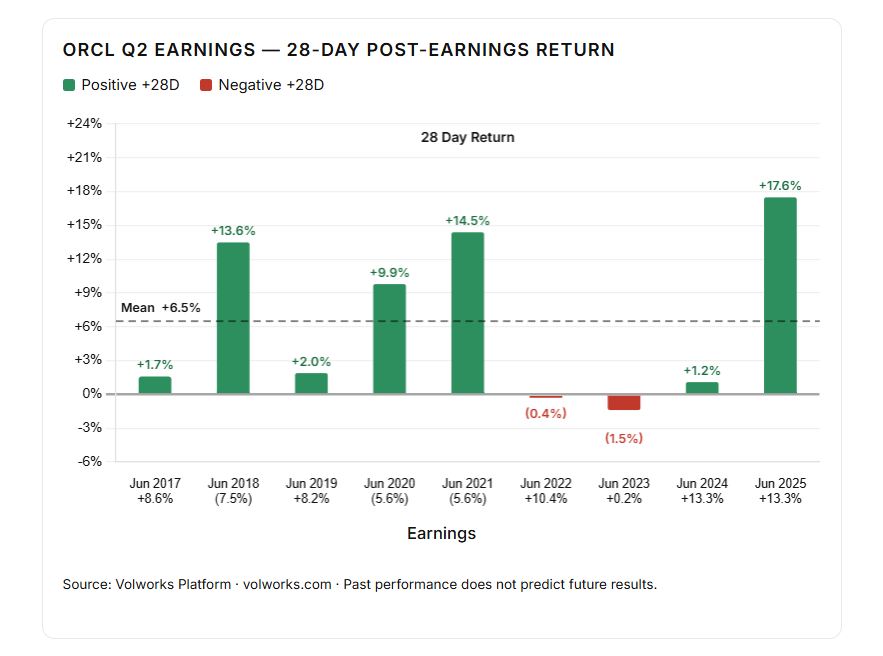
Across all 10 Q2 earnings events over the last 10 years, ORCL has produced a positive 28-day return in 7 out of 10 instances — regardless of whether the stock rose or fell on earnings day. The mean +28 day return is +6.5%.
Positive 28-day drift across Q2 regardless of earnings day direction.
Earnings
Source: Volworks Platform · volworks.com · Past performance does not predict future results.
When ORCL Moves Lower on Earnings Day
Narrowing to the 3 prior instances where ORCL declined on Q2 earnings day, the +28 day drift has been notably consistent. Every prior Q2 down event has been followed by a positive return at +28 days, with a mean return of +12.7%.
All 3 prior Q2 down events produced positive returns at +28 days.
Today’s (8.53%) decline is the largest Q2 earnings day drop on record (10 Years) — the prior worst was (7.5%) in June 2018, which was followed by a +13.6% return at +28 days.
ORCL — Post-Earnings Performance, Q2 Down Events
| Date | Earnings Day | +28 Days |
|---|---|---|
| Jun 2018 | (7.5%) | +13.6% |
| Jun 2020 | (5.6%) | +9.9% |
| Jun 2021 | (5.6%) | +14.5% |
| Source: Volworks Platform · 3 Q2 down events for ORCL over 10 years. | ||
Implications for Advisors
The historical data is consistent: ORCL has drifted higher at +28 days after Q2 earnings in 7 of 10 instances, and in every prior Q2 down event.
- Advisors holding long ORCL positions may want to think twice before writing covered calls over the next 30 days, given the stock’s historical tendency to recover meaningfully following a Q2 decline.
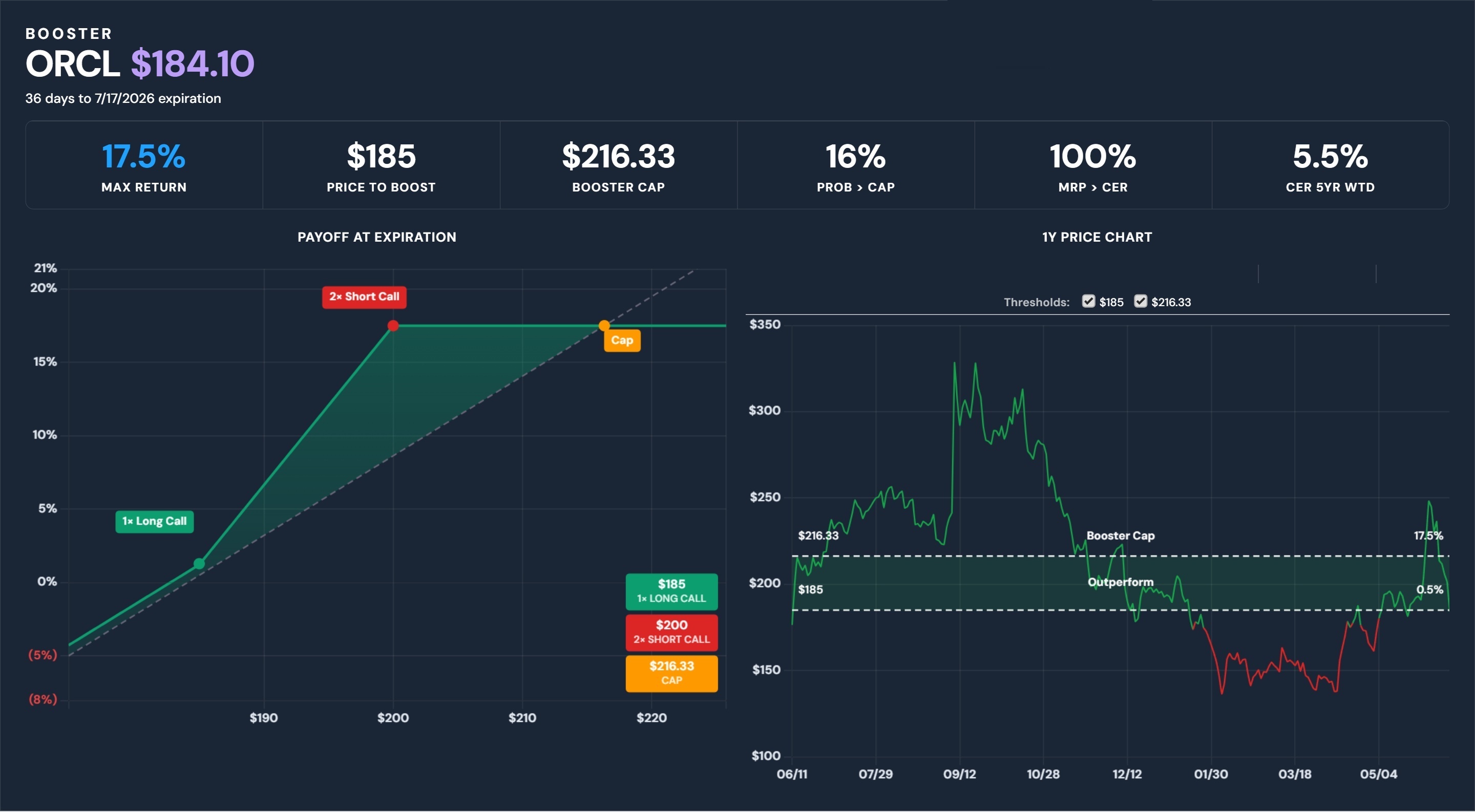
- An interesting trade is a 36-day Booster (1x2) call spread overlaying a long position, expiring July 17, 2026. With ORCL at $184.10, the structure offers a 17.5% max return. The trade outperforms long stock ownership from $185–$216.33. Below is the payoff chart of the trade with indicative pricing as of the close on June 11, 2026.
Disclosures: This article is for educational purposes only and does not constitute investment advice or a recommendation to buy or sell any specific security. Options involve risk and are not suitable for all investors. Past performance is not indicative of future results. Probability estimates are model outputs based on implied volatility and are not guarantees. Cap management depends on prevailing market conditions; the ability to roll, rebalance, or unwind is not guaranteed at any specific price.